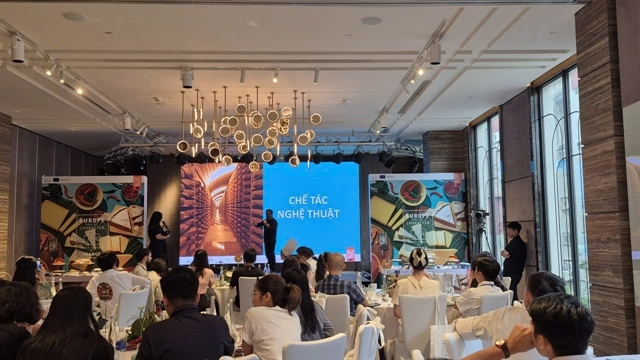
Organized by the Centre National Interprofessionnel de l’Économie Laitière (CNIEL) and supported by the European Union, this event is part of a broader initiative celebrating French cuisine in Vietnam.
CNIEL represents the entire French dairy industry, from farmers and producers to distributors and researchers. With EU backing, it conducts global programs that highlight France’s reputation as the ‘world’s cheese cradle,’ a legacy spanning millennia.
François Robin, a French cheese expert, highlights three critical factors in crafting exceptional cheese: high-quality milk, the cheesemaker’s expertise, and the maturation process. He compares cheese-making to baking, where precision and experience are key to success.
“Following a recipe doesn’t guarantee perfection. Making cheese is straightforward, but creating truly exceptional cheese is an art,” Robin notes.
According to Robin, milk quality is paramount in determining flavor. Farmers must nurture their cattle, provide natural feed, respect their growth patterns, and protect the environment to produce superior milk.
France’s tradition of small-scale farming, with an average of 60 cows per farm, is often a multi-generational family endeavor. Notably, 90% of dairy cows graze on pastures for at least six months annually, with dry hay reserved for winter. This dedication yields the high-quality milk essential for premium cheese.
In many small, mountainous farms, French farmers use traditional methods to milk cows and craft cheese. The process involves coagulating milk with lactic culture, cutting it, pressing it into molds, and aging it in caves under controlled temperature and humidity.
During aging, natural microorganisms and molds develop, creating distinct flavors, textures, and rinds. Some cheeses are enveloped in edible white mold, while blue cheese gains its unique flavor through a technique that introduces air to promote mold growth.
“A great cheese is a living cheese,” Robin emphasizes.
France boasts 3,423 officially recognized cheese varieties, listed on CNIEL’s website. Considering variations and preparation methods, this number could reach 5,000. Cheeses range from palm-sized to over 120kg, with each region showcasing unique recipes that reflect local traditions and creativity.
Blue cheese, distinguished by its green mold veins, stands out. Artisans use a large needle to pierce the cheese, allowing oxygen to foster mold growth, which contributes to its signature flavor.
Emilie Martin, CNIEL’s Asia-Pacific Regional Director, assures that all French dairy products undergo daily testing to ensure safety.
“Our collaborative efforts focus on quality and consumer trust. Events like the Vietnam seminar aim to share French cheese culture globally, not promote specific brands,” she explains.
When importing cheese into Vietnam, a food safety certificate is mandatory. This document details milk origin, supplying farm, and transportation and processing methods. Importers should scrutinize this information for reliability. While all French cheese complies with EU safety standards, both parties must align on labeling, storage, and certification to meet Vietnamese market requirements.
Event attendees could pair French cheese with local ingredients to discover harmonious flavors. The event concluded on September 25 with a buffet featuring renowned local delicacies, offering a rich culinary experience.

Balade en France Draws Runners and French Food Enthusiasts
Thousands participated in the third Francophonie Run at Thong Nhat Park on March 29 in Hanoi, part of Balade en France, the largest food and sporting event for the French-speaking community.
France24 in 2024: “Distinct Flavours – Sporting Spirit”

The festival of culinary arts endeavors to elevate the spirit of French gastronomy and the vibrant expression of street art.
2024 French Food Festival Opens in Hanoi
The 2004 French food festival titled “Balade En France” commenced in Hanoi on the 5th of April under the patronage of the French embassy in Vietnam and the municipal People’s Committee.
Gourmet event “Balade en France 2024” scheduled for April
Vietnam’s grandest French gastronomy celebration, ‘Balade en France’, is set to captivate Hanoi from April 5-7. This specially curated edition promises an unforgettable experience for food enthusiasts and Francophiles alike.
Explore the Flavors of France in 2023: Celebrating French Gastronomy and Wine

To commemorate the momentous occasion of France and Vietnam’s 50th anniversary of diplomatic relations and their 10 years of strategic partnership, MM Mega Market Thang Long has launched their ‘Taste France 2023’ food tasting programme.
Exploring the Culinary Treasures of Vietnam with the Élysée Palace Head Chef

For a quarter of a century, Chef Guillaume Gomez has prepared delectable cuisines from around the world for the presidents of France – and now, as he turns 45 years old, he looks back on his illustrious career.